
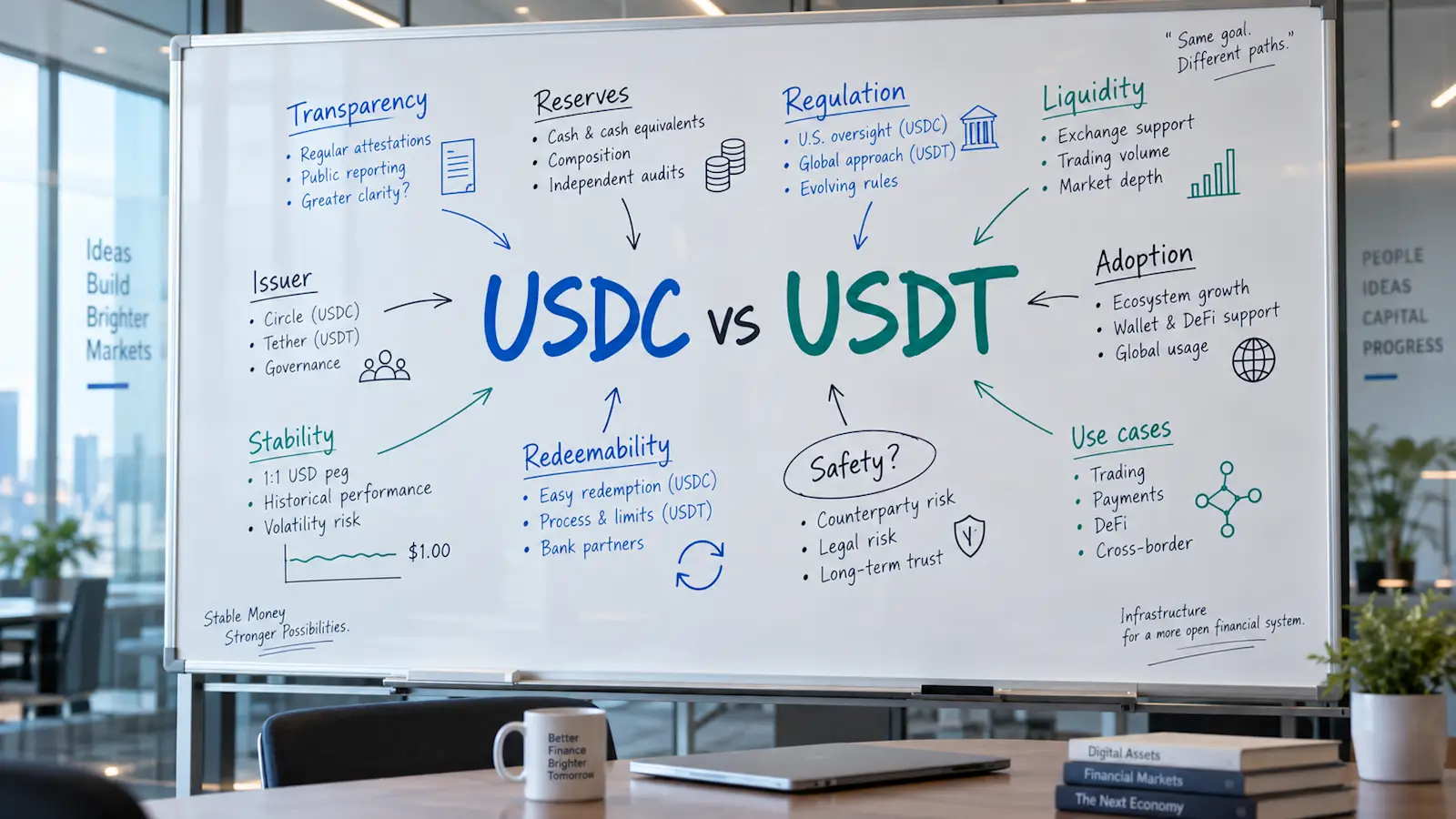
USDC vs USDT: What's the Difference and Which Is Safer?
The two largest dollar stablecoins are no longer growing in lockstep. Over the past year USDC's supply expanded by double digits, while USDT - still by far the larger coin - plateaued and slipped from its early-2026 record. Any honest USDC vs USDT comparison starts with that gap in momentum, because the usual "both are pegged to $1" opener misses what actually changed. (Market caps move fast - verify both live on CoinGecko, CoinMarketCap, or DeFiLlama.)
Here is the counter-intuitive part: both coins are fully collateralized, yet they carry materially different credit risk. After the 2022-2023 shocks - Terra, Silicon Valley Bank, exchange failures - and the 2025 GENIUS Act and MiCA enforcement, the USDT vs USDC safety question is no longer a matter of vibe. It splits into three measurable axes: reserve quality, transparency, and regulatory standing. This piece treats the comparison as analysis, not a feature list.
USDC vs USDT - Quick Answer
USDC is generally treated as the lower-risk, more transparent stablecoin, while USDT offers deeper liquidity and wider global reach. Neither is "safer" in absolute terms - it depends on the axis you measure and the job at hand. The decisive differences:
Issuer & domicile: USDC - Circle (US, NYSE-listed); USDT - Tether (operating from El Salvador).
Launch year: USDT 2014; USDC 2018.
Relative size: USDT is roughly 2.5x USDC by market cap (verify live).
Reserves: USDC holds cash and short-dated US Treasuries only; USDT adds Bitcoin, gold, and secured loans.
Verification: USDC - monthly attestations plus public filings; USDT - quarterly attestations, audit underway in 2026.
Regulatory standing: USDC is MiCA-authorised and GENIUS-aligned; USDT is not EU-authorised.
Primary use split: USDT for trading and settlement; USDC for regulated payments and savings.
What Is a Stablecoin, and How Is It Backed?
A stablecoin is a crypto token designed to hold a fixed value - usually one US dollar - by holding real-world reserves against every token issued. USDC and USDT are both fiat-backed stablecoins: each token is meant to be redeemable 1:1 from the issuer's reserves.
The model is simple, but its soundness has limits. The peg is only as reliable as the reserves behind it and the issuer managing them. A USDT stablecoin token - or a USDC token - is, in credit terms, a claim on a private company, not a dollar in your pocket. Strong, liquid reserves make that claim solid; market risk or a shaky bank weakens it.
Fiat-backed stablecoins are typically used for four things:
Trading and moving between crypto assets without touching a bank
Cross-border transfers and remittances
Holding dollar value on-chain (a cash-like parking spot)
Supplying liquidity and collateral in DeFi
What Is USDT (Tether)?
USDT is a dollar-pegged stablecoin issued by Tether, launched in 2014 and pegged 1:1 to the US dollar. It is the largest stablecoin by market cap and the most-used trading pair in crypto. Tokens are minted on fiat deposit and burned on redemption.
Tether Limited runs the token; its issuing entities were historically registered in the British Virgin Islands, and the group now operates from El Salvador as a licensed digital-asset provider. With more than 550 million users reported worldwide, USDT dominates emerging-market trading and payments.
Reputationally, Tether carries more baggage. Reserves are majority US Treasuries and repos, but also include Bitcoin, gold, and secured loans. In 2021 the CFTC fined Tether $41 million, finding it held sufficient fiat reserves to back USDT for only 27.6% of days in a 2016-2018 sample (CFTC order). In March 2026, Tether moved to close that gap by engaging a Big Four firm - reported to be KPMG - for its first full financial-statement audit.
What Is USDC (USD Coin)?
USDC is a dollar stablecoin issued by Circle, launched in 2018 and positioned from day one as compliance-first. It is the second-largest stablecoin and the preferred dollar token for regulated payments and institutional settlement.
Circle is now a public company, listed on the NYSE since June 2025 under the ticker CRCL. USDC is minted on deposit and burned on redemption, the same core mechanism as its rival - but the reserves differ sharply. USDC is backed by the Circle Reserve Fund, an SEC-registered money-market fund of short-dated US Treasuries and repurchase agreements managed with BlackRock, plus cash held at regulated banks. There is no Bitcoin or gold in the backing. In a USD Coin vs Tether comparison, that regulated, audited profile is why "is USD Coin safe?" tends to get a firmer answer than the same question about USDT.
One accuracy point worth getting right: USDC was originally governed by the Centre Consortium, a joint venture between Circle and Coinbase. Centre was dissolved in August 2023, and Circle has been the sole issuer of USDC ever since. Several widely-read guides still describe USDC as managed by "the Centre consortium" - that is out of date.
USDC vs USDT - Key Differences at a Glance
USDC and USDT diverge on five axes: transparency, reserves, regulation, liquidity, and credit risk. USDT leads on size and market depth; USDC leads on reserve quality and compliance. The table below is the anchor comparison - the fastest way to read the difference between USDT and USDC.
Attribute | USDC | USDT |
Issuer & domicile | Circle (US, NYSE: CRCL) | Tether (operates from El Salvador) |
Launch year | 2018 | 2014 |
Market cap (relative) | ~2nd largest; ~40% of USDT (verify live) | Largest (verify live) |
Reserve composition | Cash + short-dated Treasuries only | Treasuries + repos, plus BTC, gold, loans |
Transparency | Monthly attestations + public filings | Quarterly attestations; audit underway (2026) |
Regulatory status | MiCA-authorised (EU); GENIUS-aligned (US) | Not EU-authorised; pursuing US framework |
Supported chains | Ethereum, Solana, Base, Arbitrum, Polygon, Avalanche | Ethereum, Tron, Solana, others |
Daily volume / liquidity | Deep; leads on settlement | Deepest; most trading pairs |
Notable depeg event | Mar 2023 (SVB exposure) | Brief dips (2017; 2018/2022) |
Best-fit use case | Payments, savings, EU access | Trading, EM settlement |
The read is straightforward: if raw liquidity is the priority, tether vs USDC favours Tether; if reserve quality and regulatory clarity matter more, USDC takes the edge.
Reserves and Backing - What Actually Sits Behind Each Token
Both are fiat-backed, but reserve quality and volatility differ sharply. USDC holds only cash and short-dated Treasuries; USDT adds Bitcoin, gold, and secured loans that introduce market risk. That is not cosmetic - it changes how the backing behaves under stress.
Reserve component | USDC | USDT |
Cash & bank deposits | Yes (regulated banks) | Yes |
US Treasuries / repos | Yes (majority, Circle Reserve Fund) | Yes (majority, 80%+) |
Bitcoin | None | Yes |
Gold / precious metals | None | Yes |
Secured loans & other | None | Yes |
(Verify exact allocations against each issuer's latest attestation; percentages shift quarter to quarter.)
Why does composition matter more than size? Cash and Treasuries convert to dollars at par almost instantly, even in a panic. Bitcoin and gold can fall exactly when redemptions spike, eroding the buffer against a shortfall. Two issuers can both report over-collateralised reserves and still carry very different risk - because safety is about what backs the token, not just how much.
Transparency and Audits - Attestation Is Not the Same as an Audit
The core transparency gap is definitional: an attestation is a point-in-time snapshot, while a full audit is an ongoing, independent opinion on financial statements and controls. USDC has moved closer to audit-grade disclosure; USDT has relied on attestations. Most competitor guides blur this line - the distinction is the real story.
An attestation confirms that, on one chosen date, the claimed reserves appear to exist - nothing about the other 364 days, internal controls, or liabilities. A financial-statement audit covers all of that continuously, which is why regulators and institutions weigh the two very differently.
On current practice, Circle publishes monthly third-party attestations and, as a listed company, files public financial disclosures subject to securities law. Tether publishes quarterly attestations (through BDO) and, in March 2026, engaged a Big Four firm to work toward its first full reserve audit. A clean audit would narrow the biggest transparency gap between the two - but until it lands, the distinction stands.
Regulatory Status - GENIUS Act, MiCA, and What Changed in 2025-2026
Regulation is now the single biggest structural divider between the two. USDC pursued compliance and secured authorisation on both sides of the Atlantic; USDT chose not to seek EU authorisation and was delisted from EU-regulated exchanges. This is where the usdc vs tether comparison stops being about features and starts being about access.
United States. The GENIUS Act was signed into law on 18 July 2025 - the first federal framework for payment stablecoins (White House). It requires 100% backing in liquid assets, monthly public reserve disclosures, licensing, and annual audits for the largest issuers. Both are now building toward that standard - Circle through its existing US licensing, Tether through a new US-compliant token.
European Union. MiCA's e-money-token rules took full effect on 30 December 2024. Circle had already secured a French e-money licence in July 2024, making USDC MiCA-authorised. Tether declined to apply, objecting to the reserve-location rules. EU-regulated venues then delisted USDT for European customers - Coinbase from December 2024, Crypto.com in January 2025, Binance and Kraken by end-March 2025. ESMA later clarified that holding or transferring USDT is not itself banned; the restriction falls on licensed exchanges offering it.
Tether's response. Rather than reshape its reserves for MiCA, Tether pivoted to US authorisation and a compliant dollar token there. The practical consequence most guides skip: the delistings shifted European order-book liquidity from USDT to USDC. For an EU reader, "which is safer" is partly decided by venue access - on a MiCA-licensed exchange, USDC is often the only major dollar stablecoin available. (Regulatory status, not legal advice.)
Depeg History - How Each Coin Behaved Under Stress
Both coins have briefly lost the peg, but for different reasons: USDC's March 2023 depeg was a banking-exposure event, while USDT's wobbles have been confidence events. How a coin repegs reveals as much as whether it slipped.
Coin | Event & date | Low point | Recovery |
USDC | SVB failure, Mar 2023 | ~$0.87 | ~2 days (72h) |
USDT | Bitfinex hack fallout, 2017 | Brief dip | Days |
USDT | Confidence crisis, Oct 2018 | ~$0.90 | Weeks |
USDT | Terra/LUNA contagion, May 2022 | ~$0.95 | Days |
The USDC case is the clearest lesson. Circle held about $3.3 billion - roughly 8% of USDC's ~$40 billion in reserves - at Silicon Valley Bank when regulators shut it down. USDC fell to about $0.87 that weekend, then recovered within roughly two days once US authorities guaranteed SVB deposits (Circle). The bulk of reserves - the Treasury portion - was never at risk. That fast recovery is itself evidence of reserve liquidity: the episode exposed concentration risk in a banking partner but validated the Treasury-heavy structure underneath.
What Makes a Stablecoin Safe?
A stablecoin's safety rests on four testable factors: reserve quality, transparency, regulatory standing, and liquidity at redemption. Score a coin on each and you can compare it to any other.
Reserve quality: how liquid and low-risk the backing assets are (cash and Treasuries beat volatile assets).
Transparency: attestation vs full audit - and how often disclosures are published.
Regulation: whether the issuer is licensed and supervised in the markets it serves.
Liquidity / redeemability: whether reserves convert to dollars at par, fast, under stress.
These factors rarely point the same way - a coin can lead on liquidity yet lag on transparency, exactly the USDT/USDC split. So the honest answer always names the axis first.
Which Is Safer? A Credit-Risk View
"Safer" has a precise meaning in credit terms: the probability that the issuer cannot redeem your token for a dollar, and how much you would lose if it couldn't. Framed that way, the question becomes measurable - Probability of Default (PD), Loss Given Default (LGD), and Expected Loss - the same tools used for corporate bonds.
Independent assessments from Agio Ratings put real numbers on the gap. Circle is rated around investment-grade; Tether around speculative-grade.
Metric | USDC (Circle) | USDT (Tether) |
Equivalent credit rating | A-equivalent | BB+ (with parent support) / B- (without) |
12-mo probability of default | ~0.11% | ~0.69% (support) / ~14.55% (none) |
Loss given default | ~20% | Higher, support-dependent |
Primary risk driver | Operational tail events (fraud, cyber) | Leverage, dividends, BTC/gold market risk |
Reserve market-risk exposure | Minimal (cash + Treasuries) | Material (Bitcoin + gold in reserves) |
(Figures as published by Agio Ratings; verify current values.)
The gap is about structure, not whether Tether "has the money." Circle runs conservative reserves and a straightforward balance sheet, so its main risk is a rare operational event, not reserve depletion. Tether carries higher leverage, extracts large dividends, and holds Bitcoin and gold that add market risk - its stronger rating depends on discretionary parent support, and its core equity ratio sits well below the level required of regulated banks. None of this says USDT will fail; its default probability with support is still low. But the risk profile is genuinely different - which is what turns "how safe is USDC" and how safe is USDT into a number, not an opinion.
Counterparty and Issuer Risk
When you hold either coin, you hold the issuer's credit - not literal dollars. Circle's public-company structure means audited filings, securities-law oversight, and a transparent ownership chain. Tether's offshore, parent-supported structure concentrates more risk in discretionary decisions above the issuing entity - same peg, different counterparty behind your claim.
Reserve Quality and Liquidity Risk
Safety at redemption depends on how fast reserves convert to cash at par. An all-Treasury-and-cash reserve is about as liquid as private-sector backing gets. A reserve carrying Bitcoin and gold behaves differently: those assets can drop precisely when redemptions surge, widening any gap between what is owed and what can be raised at par.
Regulatory and Delisting Risk
A compliant coin carries less venue and access risk; a delisted one carries liquidity-migration risk. Because USDT was removed from EU-regulated exchanges under MiCA, European holders face thinner regulated liquidity and may need non-custodial or non-EU routes to move it. USDC, authorised across the EU, sits on the licensed venues by default - a concrete difference for anyone whose access runs through regulated platforms.
Liquidity, Trading Volume, and Real-World Use
USDT wins on raw liquidity - deeper order books, more trading pairs, and dominance across emerging markets - while USDC has grown faster and now leads on settlement and institutional payment volume, with integrations across card networks and major asset managers. The key point: liquidity and credit quality are different properties, and the most-traded coin is not automatically the lowest-risk one.
Dimension | USDC | USDT |
Market cap rank | #2 stablecoin | #1 stablecoin |
Daily trading volume (relative) | Lower, rising | Highest (multiples of USDC) |
Dominant regions | North America, EU, institutional | Emerging markets, offshore exchanges |
Typical use case | Payments, settlement, savings | Trading, remittances, settlement |
Multichain / cross-chain | Ethereum, Solana, Base, Arbitrum, Polygon, Avalanche | Ethereum, Tron, Solana, others |
So "most liquid" and "lowest risk" are not the same claim: USDT is the deeper trading rail, USDC scores higher on reserve quality and regulation. Pick per task, not per label.
In practice: Because both USDC and USDT are practical dollar on-ramps into crypto, some structured-Bitcoin platforms accept either as the deposit asset for long-term accumulation. On Binaxity's no-margin-call Bitcoin credit line, user funds and the acquired Bitcoin are held by qualified custodians on institutional-grade MPC custody infrastructure inside a bankruptcy-remote SPV that is not rehypothecated - a structure designed to reduce, though not eliminate, certain custody and price-driven-liquidation risks.
USDC or USDT - Which Should You Use?
The right choice depends on the task, not on a universal winner - each coin is optimised for different jobs. The framework below describes what each is typically chosen for; it is not a recommendation to buy, hold, or allocate anything.
Use case | Better-fit option | Why |
Active trading | USDT | Deepest liquidity and the most trading pairs |
Capital preservation / savings | USDC | Cash-and-Treasury reserves, lower risk |
DeFi | Either | Both widely integrated; depends on protocol |
Cross-border payments | USDT | Dominant in emerging-market corridors |
EU / EEA users | USDC | MiCA-authorised and listed on regulated venues |
Institutional treasury | USDC | Audit-grade disclosure, public oversight |
In reality, many users hold both and swap as the task changes. Whether usdc or usdt fits you - or whether tether or usdc suits a given corridor - depends on your own jurisdiction, venue access, and risk tolerance.
How to Hold USDC and USDT Safely
Exchange convenience trades off against custody risk: an exchange adds a third party, while self-custody removes that exposure but shifts responsibility to you. A few practical steps lower the odds of an avoidable loss.
Consider a self-custodial wallet to remove third-party custody exposure.
Convert between USDC and USDT on a reputable exchange to switch - near-1:1, negligible cost.
Keep clear records of every conversion and transfer.
Size any single-issuer exposure conservatively rather than concentrating everything in one coin.
On tax: in some jurisdictions, swapping or spending a stablecoin can be a taxable event even at near-zero gain - which is why record-keeping matters. Rules vary widely, so check your own situation with a qualified advisor rather than assume what is or isn't taxable.
For readers weighing reserve and custody exposure against long-term Bitcoin exposure funded in stablecoins, Binaxity's structured Bitcoin credit line - with assets held by qualified custodians in a bankruptcy-remote SPV - is one option worth understanding.
FAQ
Is USDC safe?
USDC is widely regarded as one of the lower-risk stablecoins, backed by cash and Treasuries with monthly attestations. The honest caveat is banking exposure - in March 2023, reserves at a failing bank briefly pushed it off its peg.
How safe is USDT?
USDT is widely used and mostly stable, but carries issuer credit and transparency risk. Independent assessments rate it speculative-grade, mainly due to leverage and Bitcoin/gold reserves - a low but non-trivial risk, not a certainty of failure.
What is the difference between USDC and USDT?
Both share the same $1 peg but differ in issuer, reserves, transparency, and regulation. USDC uses cash and Treasuries under a US public company; USDT adds volatile assets and operates offshore.
Is USDC and USDT the same?
No. Both are dollar stablecoins, but they differ in issuer, reserve quality, and regulatory standing - same face value, different credit behind each token.
Which is safer, USDC or USDT?
On transparency, reserves, and regulation, USDC is generally assessed as lower-risk; USDT leads on liquidity. There is no absolute answer - it depends on which axis matters most to you.
Why did USDC depeg?
USDC depegged in March 2023 because about $3.3 billion of its reserves were stranded at Silicon Valley Bank when it failed. It fell to around $0.87 and recovered within roughly two days.
Is USDT fully backed?
Tether states its reserves exceed circulating supply, per its attestations. The caveat: an attestation is a point-in-time snapshot, not a full audit - the 2026 audit aims to close that gap.
Can I convert USDT to USDC?
Yes. Most major exchanges and on-chain swap venues let you convert between the two at close to 1:1 with negligible cost - the pair is among the most liquid in crypto.
Are USDC and USDT taxable?
In some jurisdictions, disposing of a stablecoin can be a taxable event even at near-zero gain; in others it may not be. Rules vary, so consult a qualified advisor for your own jurisdiction.
What is the downside of USDC?
The main downsides are centralization (a single issuer), reliance on banking partners - the source of SVB-style exposure - and smaller liquidity than USDT. By design, it never appreciates.
Why is USDC losing market cap?
A falling USDC market cap usually reflects supply shrinking as holders redeem or rotate elsewhere - not the price leaving its $1 peg. Supply fell in 2022-2023 and has since recovered strongly.
Can I move USDC or USDT to my bank account?
Not directly. Convert the stablecoin to fiat on an exchange first, then withdraw the dollars. Most banks do not hold stablecoins natively, so the exchange is the bridge.
Where can I buy USDC and USDT?
Both trade on major centralized exchanges and via on-chain swaps. Note that EU/EEA venues generally list USDC but not USDT after MiCA. This is not an endorsement of any platform.
What is the difference between USD and USDT?
USD is government-issued fiat currency, backed by the state. USDT is a private digital token pegged to the dollar and backed by Tether's reserves - sovereign money versus a company's dollar claim.
Which stablecoin is best for beginners?
It depends on use case and region. EU users often default to USDC because regulated exchanges list it; elsewhere, USDT is convenient for trading. Neither is a universal "best."