
The Next Evolution of Embedded Finance: Turning Assets Into Financial Opportunity
Financial platforms have transformed how people move, save and invest money. The next opportunity may be helping customers do more with the assets they own — and build the assets they want to own.
Over the past decade, financial services have increasingly moved inside the digital experiences consumers already use.
Payments became embedded. Banking became embedded. Credit became embedded. Investing became dramatically more accessible.
Yet an important gap remains.
Millions of customers now own or want to own investable assets, but the financial products available around those assets remain relatively limited.
A customer who needs liquidity may have to sell an investment they would prefer to keep.
A customer who wants to build wealth may be limited to investing only the capital they have available today.
And a financial platform that wants to solve either problem can face the prospect of building an entirely new lending, funding, underwriting, servicing and risk infrastructure.
We believe there is another way.
From Embedded Finance to Embedded Wealth
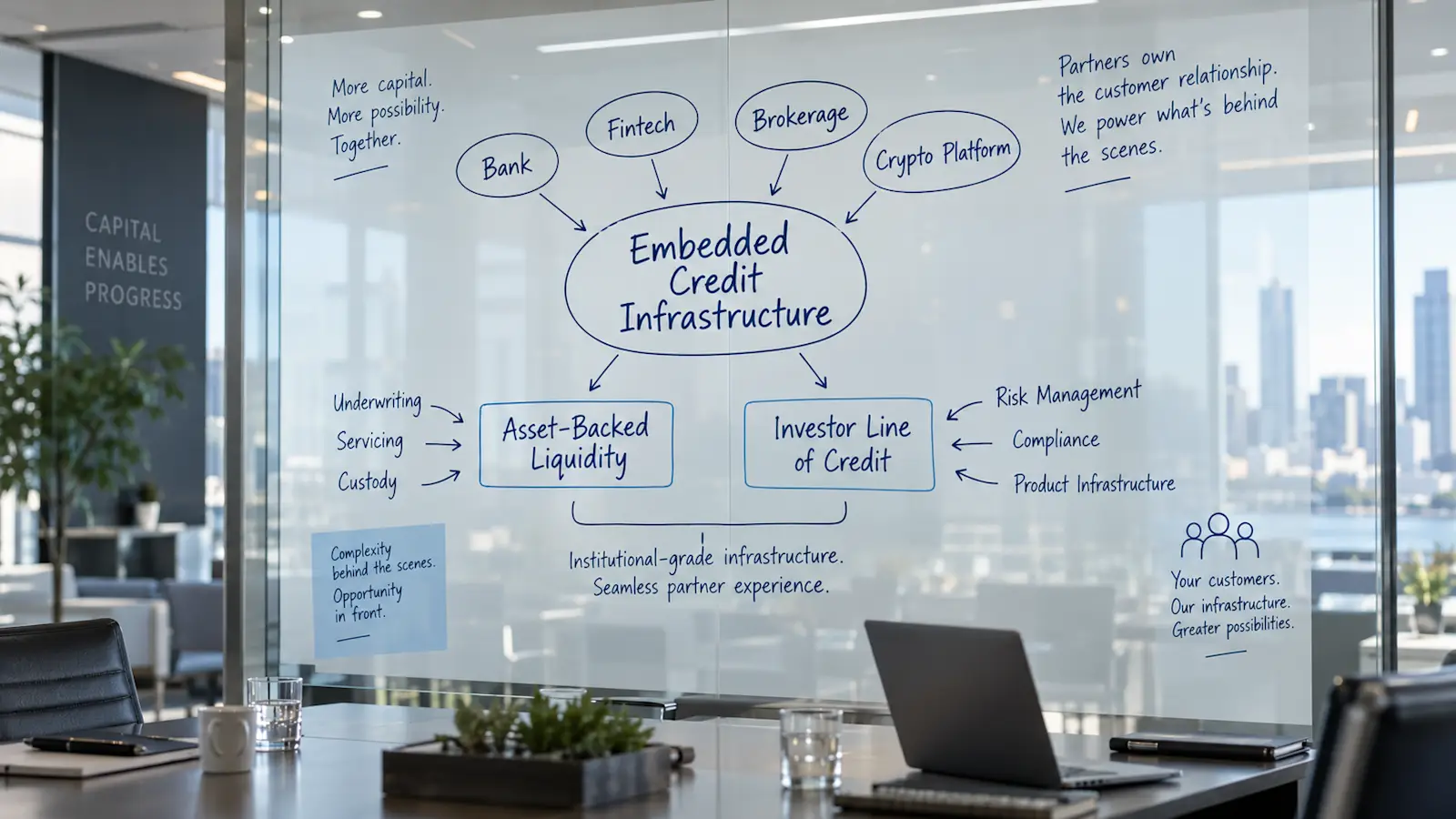
Binaxity is building an embedded financial infrastructure platform designed to help financial institutions and consumer platforms offer new products around investable assets.
The premise is straightforward:
Partners already have the customers, distribution and trusted financial relationship. Binaxity provides the infrastructure to help them add new financial capabilities around that relationship.
Rather than building a specialized credit platform internally, a partner can integrate Binaxity into its existing customer experience and offer new wealth-building and liquidity products under a white-label or grey-label model.
The partner remains at the center of the customer relationship.
Binaxity powers the infrastructure behind the product.
Two Sides of the Same Opportunity
At the heart of the Binaxity platform are two complementary customer needs.
Build
For customers who want to build investment exposure, Binaxity's Investor Line of Credit (I-LOC) combines customer capital with investment credit to increase purchasing power.
A simple example illustrates the concept:
$500 customer capital + $500 investment credit = $1,000 of investment exposure.
The structure is designed without traditional margin calls or forced liquidation, creating an alternative to conventional margin-based investment lending.
Instead of credit being used primarily to finance consumption, the I-LOC uses credit as a tool to help eligible customers acquire and build assets.
Access
The other side of the platform addresses customers who already own assets.
Binaxity's asset-backed liquidity capability is designed to allow eligible customers to access capital against assets they own without having to sell those assets simply to generate liquidity.
The customer can therefore potentially maintain exposure to an asset while unlocking some of its financial value.
Together, these capabilities address a broader financial lifecycle:
Build assets. Hold assets. Access liquidity from assets.
The Asset Is a Variable, Not the Platform
One of the most important aspects of this model is that Binaxity is not being built around a single asset.
The platform is designed to be asset-flexible.
Current product development includes Bitcoin and tokenized gold, providing very different underlying investment propositions within the same broader infrastructure.
Bitcoin can address customers seeking exposure to a digital asset.
Tokenized gold can provide access to a digital representation of an asset that has served as a store of value for centuries.
As financial markets evolve and more assets become available in digital and tokenized form, the same infrastructure is designed to accommodate additional eligible asset classes and product configurations.
That distinction matters.
For our partners, the starting question doesn't need to be:
“Do our customers want Bitcoin?”
A more useful question is:
“What assets and financial capabilities are relevant to our customers?”
The product can then be configured around the partner, customer segment and market.
Why This Matters for Financial Platforms
Financial platforms already possess something extraordinarily difficult to build: customer relationships and distribution.
A bank may have millions of depositors.
A brokerage already has customers investing through its platform.
A crypto exchange or wallet has customers holding digital assets.
A fintech or neobank may sit at the center of a customer's everyday financial life.
A telco or large consumer platform can have enormous reach into populations that traditional wealth providers have struggled to serve economically.
The challenge is turning that distribution into new financial capabilities without requiring every organization to become a specialist asset-backed lender.
That's the role Binaxity is designed to play.
Infrastructure Behind the Experience
Launching an asset-backed financial product involves considerably more than adding a button to an app.
Depending on the product and market, the underlying operating model can require technology, funding, underwriting, risk management, servicing, custody, fraud controls and compliance workflows.
Binaxity's embedded platform is designed to bring these capabilities together.
Through API and SDK connectivity, Binaxity can integrate with a partner's existing digital environment while supporting capabilities across:
Product and credit infrastructure
Capital and funding
Underwriting and decisioning
Risk management
Fraud controls
Servicing
Asset and custody infrastructure
Compliance and onboarding workflows
The precise allocation of responsibilities can vary by partner, product and jurisdiction.
What remains consistent is the objective:
Make sophisticated asset-backed financial products easier for established platforms to offer their customers.
Built Around the Partner — Not the Other Way Around
There shouldn't be one version of embedded wealth for every financial platform.
A brokerage may see an opportunity to help customers build greater investment exposure.
A crypto platform may want to provide liquidity or additional financial utility around assets its customers already hold.
A fintech or neobank may want to add wealth-building products alongside payments, savings and credit.
A telco or consumer ecosystem may want to make investing accessible through small, recurring customer contributions.
A financial institution may be interested in an entirely different asset, customer segment or product configuration.
Binaxity's role is not to force those partners into a predetermined customer experience.
It is to provide a reusable infrastructure layer from which different products can be built.
Why Now?
The underlying financial landscape is changing.
Consumers increasingly interact with financial services digitally. Investment access has expanded beyond traditional wealth-management channels. Digital assets have introduced new forms of ownership, while tokenization is creating new ways to represent and transact in traditional assets.
At the same time, embedded finance has demonstrated that customers don't necessarily need another standalone financial application. Financial capabilities can increasingly be delivered through platforms and brands with which they already have a relationship.
That creates an opportunity to rethink the role of credit and investable assets inside those experiences.
Credit doesn't only have to help people spend today and repay tomorrow.
It can also be structured to help eligible customers build assets over time.
And assets don't necessarily have to be sold when customers need liquidity.
They can potentially become the foundation for accessing it.
A New Infrastructure Layer for Financial Platforms
This is the larger opportunity Binaxity is pursuing.
Not a Bitcoin product.
Not simply a lending API.
And not another consumer financial app competing with partners for their customers.
Binaxity is building an embedded infrastructure layer designed to connect credit with investable assets.
That infrastructure can enable partners to help customers build greater investment exposure through products such as the I-LOC, access liquidity against assets they already own, and introduce additional asset-backed financial products as markets evolve.
One platform. Multiple products. Multiple assets. One existing customer relationship.
For financial institutions and consumer platforms, the question is ultimately not what Binaxity wants to sell their customers.
It's much more interesting:
What could your platform offer its customers if the asset, credit and infrastructure layers were already there?
If your organization is exploring embedded wealth, asset-backed liquidity or new ways to create financial utility around investable assets, we'd like to hear from you.
Contact the Binaxity Partnerships Team at [email protected].